
TIME TO REVIEW DEGREE CHOICES IN KENYA OR DARE ABROAD
Robert, an ambitious young Kenyan, asked me today for advice on revising his degree choices in light of the wave of digital transformation. He keenly followed the 7th Youth Talent and #Career Fair I conducted on 22.02.2020. COVID-19 had not been detected in Kenya yet.
Robert couldn’t help but remember this excerpt from my presentation with laser precision: “For every two jobs lost to automation, three new jobs are created. What has automation done to journalism and banking? The Washington Post is an exemplar of Artificial Intelligence (AI) in automated journalism. Commerzbank had successfully experimented with AI-generated equity research reports. Now, think of the new job of a Human-to-Machine Matching Manager or the evolution of the traditional role of a Surveyor to become the modern Geodata Modeller and Manager handling unstructured and big data from satellites, GPS, laser scanners, drones, echo sounders, and even smartphone-based mobile alerts. The disruptive effect of digital technologies is quickly reducing the half-life of skills, making lifelong skills development a necessity rather than a luxury. Today’s workforce must keep upskilling, reskilling, and even deep-skilling to sustain market relevance.”
It was an uphill challenge to meet Robert’s high expectations since the future is hard to predict. Therefore, I chose to remain as objective as possible, not pushing my own agenda influenced by disciplinary background or where I work, Taita TavetaUniversity Voi. The advice I gave Robert could well be of benefit to other Kenyan youths revising their degree choices.
LOOK BEYOND HERE AND NOW
As you, a dear Kenyan student, revise your degree courses, please take time to balance your fascination with historically prestigious names like medicine, engineering and law with the other realities shaping #Africa‘s key #SDG challenges, the digital economy, and the #future of #work. The food-water-energy nexus will remain critical to local development, but there will be an increasing need for technological innovation to make #agriculture, #agribusiness as well as the management of #water and #energy resources smart – transforming the sectors into expanding job creators for youths with industry-relevant digital skills.
Think borderless, beyond your territory. Seek out ways of acquiring transferable #skills, not confining your work vision to one geographical region or one narrow disciplinary sub-branch. Talking of the Future of Work and Workers, the chilling threat of having robots taking your job is a reasonable concern and you can check the level of risk to any job from this link: Will Robots Take My Job?
?ℕ?????ℕ? ??? ????????ℂ? – PARENTS, NOT TEACHERS, ARE THE MAIN EXTERNAL INFLUENCERS
From the last #ImpactBorderlessDigital series of the progressive #YouthAgenda we held, we saw the key statistics revealing that 65% of primary schoolers will handle post-college jobs that don’t exist yet as of now. Barely 30% of agricultural products undergo industrial processing in developing countries compared to 98% in high-income countries. Infrastructure constraints cut business productivity by up to 40% due to the resultant high cost of doing business. Who will confront the challenge to upgrade from admirers of development outcomes to actors causing transformation through prudent training choices? Who will cause the desired change, if not you as the change agent?
When it comes to choosing a career line, teachers (6% of the cases) have been thought of as the main influencers but mistakenly so. This recent research finding revealed that it is parents (17% of the cases) who are the main external agents influencing the youth to choose courses. Only about 30% of Kenyan youth choose careers out of their own self-drive and passion.
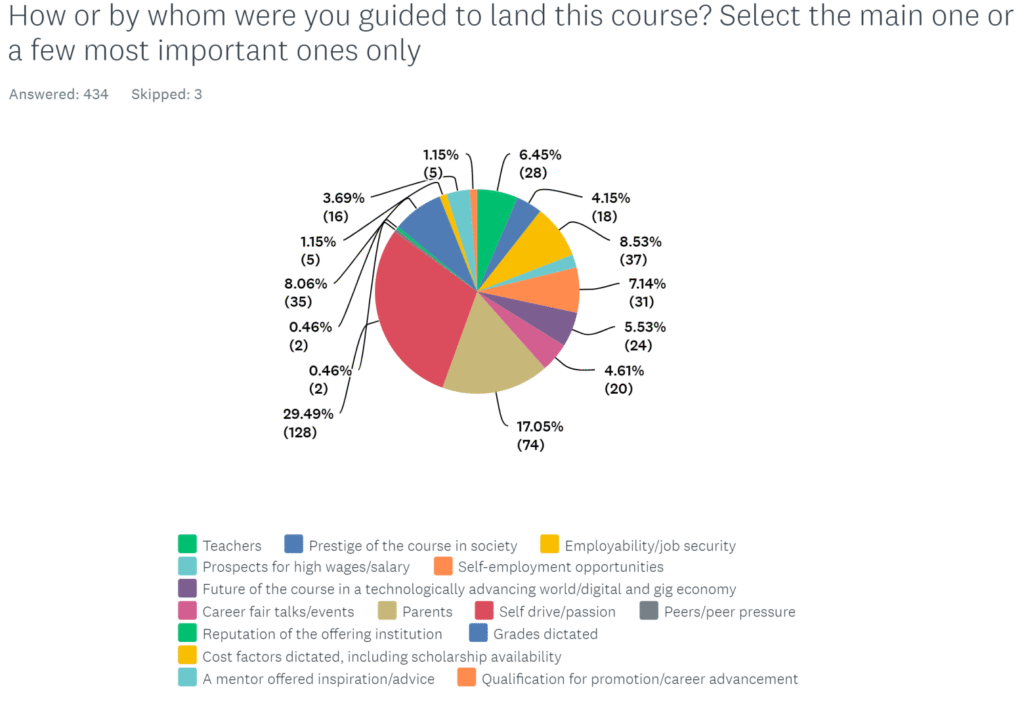
Source: Adero (2021) – Youth skills survey under The University of Ideas – ACCESS Idea Competition for African lecturers.
???? ???????, ??????? ?????, ??????????? ????????? ??????????? & ?????????? ???????, ???????? & ?????????? ????????????
Data- and technology-driven decision-making will be increasingly relevant in the key sectors of #education, #finance, #agriculture, #energy, #infrastructure, #manufacturing, #transport, #mining, #sustainablity science, #demographics, #conservation, among others. This global trend will enhance the role of computer-based automation and mathematical modelling. Applied #mathematics and applied precision sciences and technologies are gaining prominence. Keep an eye on #ICT and #geospatial technologies that provide artificial intelligence and location intelligence for smart agriculture, smart mining, smart transportation, smart buildings, smart contracts, #blockchain, and so on. Airborne and spaceborne technologies for imagery and Earth observation are still largely unexploited – both great opportunities for physical planning, environmental monitoring, and disaster preparedness. Directed by your talents, consider applied arts, business, science and engineering courses that offer you opportunities for creativity and innovations for #materials in #manufacturing, improving #food production and agricultural management systems, renewable energy technologies, marine and maritime research, ICT integration into infrastructure planning and the #SME value chain, #geomatics and #geospatial intelligence, as well as #geoengineering and #geosciences. The following examples came out of my discussion with Robert, which he still had to filter through the sieve of his own talents. Where do you rate yourself? That’s the question you must now answer yourself to serve the world with the best version of your unique self.
THINK TVET
Your choice mustn’t be realised at a university-degree level, so if you qualify for Technical and Vocational Education and Training (TVET), run for it. Remember that a stable pyramid is broader at the bottom, so TVET should draw more trainees than universities. Only less than 20% of high school graduates qualify directly to join universities in Kenya, 19.4% for the 2020 group and 17.6% for 2021 group to be exact. Examining keenly, one engineer should work with three technologists and one technologist needs the support of four technicians. #TVET is where you acquire skills-based training to be a technologist or technician. In Germany, for example, skills-based higher education is conducted at the so-called universities of applied sciences, which are basically degree-offering polytechnics. The engineers from these institutions are tough and they have given Germany the authentic engineering image that makes “Made in Germany” an unrivalled brand. You cannot despise that Mercedes Benz (Engineered to move the human spirit), Audi (Truth in engineering), BMW (Freude am Fahren – Pleasure to drive), or VW (Das Auto – The car/Play or get played) anymore than you can despise the role of TVETs.
Our TVETs in Kenya will impart similar practice-oriented skills and allow you to later graduate to advanced degrees if you like. Again, as shown in the diagram below from the findings of a nationwide youth (aged 18-35) survey conducted in 2021, a whopping 79% of the youth are willing to join TVET so as to graduate with market-ready skills and thereby cheat the beast of youth unemployment.
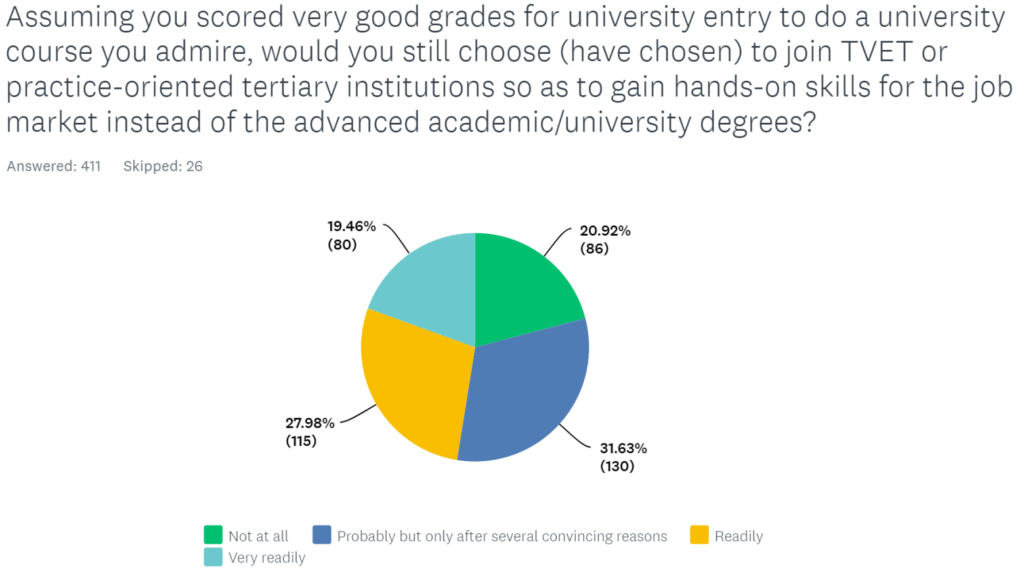
Source: Adero (2021) – Youth skills survey under The University of Ideas – ACCESS Idea Competition for African lecturers.
Talking of Kenya’s Vision 2030, note that the population of Kenya is expected to hit 60 million by 2030. One engineer should serve 2000 citizens for an optimal ratio, meaning that we will need 30,000 engineers, hence 90,000 technologists and 360,000 technicians. TVET is the training ground for the 450,000 professionals in this breakdown!
Here is a list of courses to consider choosing from:
1. Computer, Electronics & ICT-related science and engineering
2. Materials Science & Engineering
3. Applied Mathematics, Statistics and similar Data Science subjects
4. Marine & Mining disciplines
5. Geomatics, Geospatial & Geoinformatics (GIS) courses
6. Built environment including Building Information Management #BIM, Construction Management, Land Economics, Building Economics/Quantity Surveying
7. Biochemistry, Health and Biomedical studies
8. Food Technology
9. Agricultural & Agribusiness courses
10. Geology, Geophysics and similar Geosciences
11. Environmental management and climate-related disciplines
12. Economics and Business IT
13. Film and animation
14. Hospitality
15. Urban/Spatial Planning and Development Studies including Demography
Robert just found himself and chose from no. 5 above. It could be different for you, but you are now rich with information. His cousin who maintained a pensive mood throughout the interactive session, however, wanted to dare abroad and found this next section highly resourceful.
INTERNATIONAL SCHOLARSHIP – YOUR PASSPORT TO THE WORLD
Heard of a Fullbright scholar, a DAAD scholar, a Humboldtian? How do you earn them? To some, daring abroad is an irresistible option and they may just end up with these titles.
Due to the large number of candidates, undergraduate scholarships are not as readily accessible as postgraduate scholarships. Look out for special programmes dedicated to undergraduate scholarships, the famous Wings to Fly in Kenya included. Fortunately, some countries have universities that do not charge any fees, so international students only have to meet their accommodation, health insurance and upkeep costs in the foreign country. Germany has been a stellar example in this case. For lovers of engineering and courses at the cutting-edge of technology, this university in Germany is worthy of your attention: KIT – Karlsruhe Institute of Technology
The following scholarship sources are a must-read:
Scholarships in 2022-2023 | List of Fully funded Scholarships (fulbrightscholarship.net)
Scholarships – CEMEREM (ttu.ac.ke)
It is important to note the mandatory pre-prequalification tests for international students aspiring to join universities in Europe and North America. An A-level certificate may be required, meaning that O-level/KCSE graduates should pursue a further step to learn more and sit the qualifying exams needed to meet the minimum entry requirements. The pre-qualification tests may take the form of English proficiency or the foreign languages of instruction in the destination country e.g., German for undergraduate courses in Germany. Confirm if TOEFL, GRE, or GMAT tests are required for joining the universities of your choice, especially in North America.
Planning months in advance is not an option so as to meet the strict deadlines, having all the certificates and referee letters ready as well as letters of motivation and any required research proposals. Such requirements are even more critical for Master and Doctoral scholarships.
???????, ?? ? ??????????? ??????? ??? ??????-????? ????????????, ??? ???’? ???? ??? ????? ?? ????? ??? ?? ??? ????? ??? ???????. ??? ???? ?? ??? ?? ???? ????????? ?????????? ?? ??? ???? ??????? ?? ??? ?????????? ?? ?????????? ?????????? ??????? ??????? ?????????. ???????? ??? ????? ???????: ??? ???? ????? ?????? ? ????? ?? ??????? ?? ???? ?? ???? ????. ????? ??? ???????? ??? ??????? ????? ?? ??????.
For more in-depth sessions on youth mentorship for career development, keep checking the IBD Event Calendar. For more up close and personal, the Founder of IBD will you through the following topics through the lens of local and international experience at a typical IBD Youth Talent and Career Fair.