

A Bold Analysis by Impact Borderless Digital (IBD)
“What 2024 signalled as a turning point, 2025 has confirmed as a structural shift: gender balance has tipped in favour of female enrolment; enrolment has surged to projected limits, and performance gains, while real, still wrestle with a stubborn wagging tail in a pool of Ds.”
— Founder, Impact Borderless Digital (IBD)
If you are a candidate for university admission, remember that as the Centre of Excellence for Mining, Environmental Engineering and Resource Management, Taita Taveta University’s School of Mines & Engineering offers progressive Bachelor, Master and PhD degree programmes that prepare future-ready mining engineers, environmental engineers, and process engineers for Africa’s minerals and green transition era.
Context and Continuity from 2024
Seen through the same tabula rasa lens applied in the 2024 analysis, the 2025 KCSE results are less of a surprise and more of a confirmation year. Where 2024 broke records, 2025 consolidates trends. Where 2024 hinted at future pressure points, 2025 exposes them quantitatively.
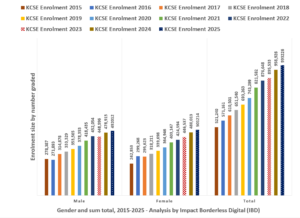
The #IBDSeries projection made in 2023—that Kenya should prepare for a million KCSE candidates by 2025—has now materialised almost to the unit digit. With 993,226 candidates graded in 2025, the system has effectively crossed the psychological and logistical threshold of mass secondary completion.
Overall Enrolment and Gender Distribution (2025)
Total candidates graded: 993,226
-
- Female: 501,214
-
- Male: 492,012
For the second consecutive year, female candidates have outnumbered male candidates, continuing the historic shift first observed in the 2024 KCSE analysis. This is no longer a statistical curiosity; it is now a trend with policy implications.
From a systems perspective, 2023 marked parity, 2024 marked overtake, and 2025 marked entrenchment.
Performance Structure: What Changed, What Held
Upper-End Performance: Incremental but Real Gains
-
- The A and A– grades remain small in absolute share (≈1.1%), but their absolute numbers increased, driven largely by enrolment expansion rather than grade inflation.
-
- This mirrors the post-2016 “quality-controlled equilibrium” noted in the 2024 analysis, where gains are earned, not massaged.
The Middle Band (C+ to B–): Slow Upward Drift
-
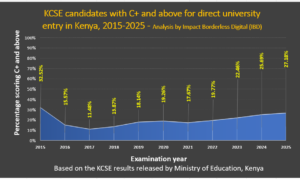
- 27.18% of candidates scored C+ and above in 2025, the highest share since the post-reform era began, surpassing 2024’s 25.69%.
-
- This confirms a gradual thickening of the middle, not a leap at the top.
The 2015–2025 trend curve shows this clearly: the slope has steepened since 2021, suggesting cumulative effects of retention, teacher stabilisation, and post-COVID academic normalisation.
The Tail-End Reality: The Long Tail Still Wags
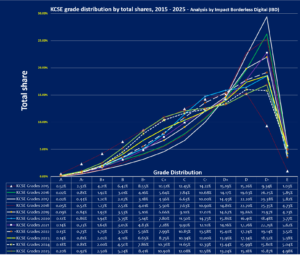
Despite improvements, the bottom cluster (D+ to E) still accounts for half of the candidates.
This is where the metaphor introduced earlier remains painfully apt:
Kenya’s KCSE distribution still exhibits a long tail, wagging persistently in a pool of Ds—less violent than before, but far from dry.
What is different in 2025 is not the disappearance of the tail, but its slow contraction:
-
- The share of D and D- has declined steadily since the 2016-2018 peaks.
-
- However, the absolute numbers remain large because the candidature itself has expanded.
In other words, relative improvement is being masked by demographic scale.
Gender Dynamics: Beyond Enrolment Numbers
While girls now outnumber boys in candidature for a second consecutive year:
-
- Boys still dominate the extreme lower tail (D- and E), a pattern already flagged in the 2024 KCSE Analysis.
-
- Subject-level data (not grade-by-gender aggregates) continues to show boys outperforming girls in most STEM subjects, while girls maintain strength in languages and humanities.
The implication is clear: retention has worked; transformation of outcomes must follow.
Similarities Between 2024 and 2025
- Rising enrolment driven by transition and retention policies
- Female candidates maintain numerical advantage
- Incremental gains in C+ and above
- Persistent dominance of the D+ to E band/tail
- Post-2015 integrity of results holding firm
What Makes 2025 Different
Projection Realised
-
- The one-million-candidate forecast is no longer speculative; it is an operational reality.
Gender Shift Becomes Structural
-
- Two consecutive years of female majority signals durability, not anomaly.
Middle-Band Thickening Accelerates
-
- The C+–B- band shows clearer momentum than in 2024.
Policy Stress Test Year
-
- University funding, TVET absorption, and youth employment systems are now under maximum demographic pressure.
Salient Policy Implications (IBD Lens)
1. Protect the Gender Gains
Female enrolment dominance must be matched with investment, especially in STEM pathways, mentorship, and psychosocial support—echoing the earlier GraFA-based education research findings on the higher budget needs of female learners than their male counterparts if they are to transition into STEM-oriented higher education and careers (see Chapter 5 of this book).
2. Treat the Tail as a System, Not a Failure
The “pool of Ds” is not an indictment of learners but a signal of misaligned pathways. TVET expansion, NYOTA-type interventions, and regional targeting are no longer optional.
3. Plan for Scale, Not Exceptions
With a million-plus candidates annually, a policy designed for elites will fail by arithmetic alone.
4. Implications for CBE and Universities
CBE must now operate at scale, not in pilot modes anymore, complete with well-equipped training institutions and continuously empowered teachers and teacher educators. With near-million cohorts and a thickening middle band, assessment must emphasise diagnostic feedback, differentiated pathways, and early talent tracking, not just certification. Universities must prepare for larger, more diverse intakes, strengthen foundation and bridging programmes, expand TVET–university articulation and progression pathways as envisaged by the Kenya National Qualifications Authority, and align curricula with industry-responsive, competency-driven learning, especially for STEM and green-transition skills.
Conclusion
The 2025 KCSE results confirm Kenya’s arrival at a new equilibrium:
-
- mass secondary completion,
-
- sustained female participation advantage, and
-
- slow but measurable improvement in learning outcomes.
Yet the system remains characterised by a heavy lower tail, reminding policymakers that demography can outrun reform if absorption systems lag behind. The long tail is shortening—but it is still wagging notoriously.
As Impact Borderless Digital projected in 2023 and confirmed in 2025, the challenge is no longer access alone, but alignment: aligning education outcomes with funding models, labour markets, and differentiated post-school career pathways.
Drawing from the German model, education systems must institutionalise multiple, well-defined exit and re-entry routes within college–industry pipelines. In Kenya’s new Competency-Based Education (CBE) framework, this means deliberately enabling young people to work while they study, recognising that lifelong learning and continuous skills development are now the norm, not the exception.
With the right policy coherence, strong industry linkages, and robust recognition of prior learning (RPL), TVET institutions can play a pivotal role in equipping and empowering Kenyans to access decent work (SDG 8) and to meaningfully improve labour-market participation.
Join the Centre of Excellence for Mining, Environmental Engineering and Resource Management, Taita Taveta University’s School of Mines & Engineering (SME) for Bachelor, Master and PhD degree programmes that prepare future-ready mining engineers, environmental engineers, and process engineers.
Documenting impact. Inspiring possibility. Engineering the future.
SME magazine download link: https://bit.ly/3YQHgGZ
Great analysis. I’m curious to know what could be the cause of the gender enrollment shift
More boys drop out of secondary schools
Insightful analysis, the female enrolment lead shows how retention policies are working while highlighting the need to better support boys in secondary school.
Boys will indeed need increasing support levels for us to have a functioning society.