

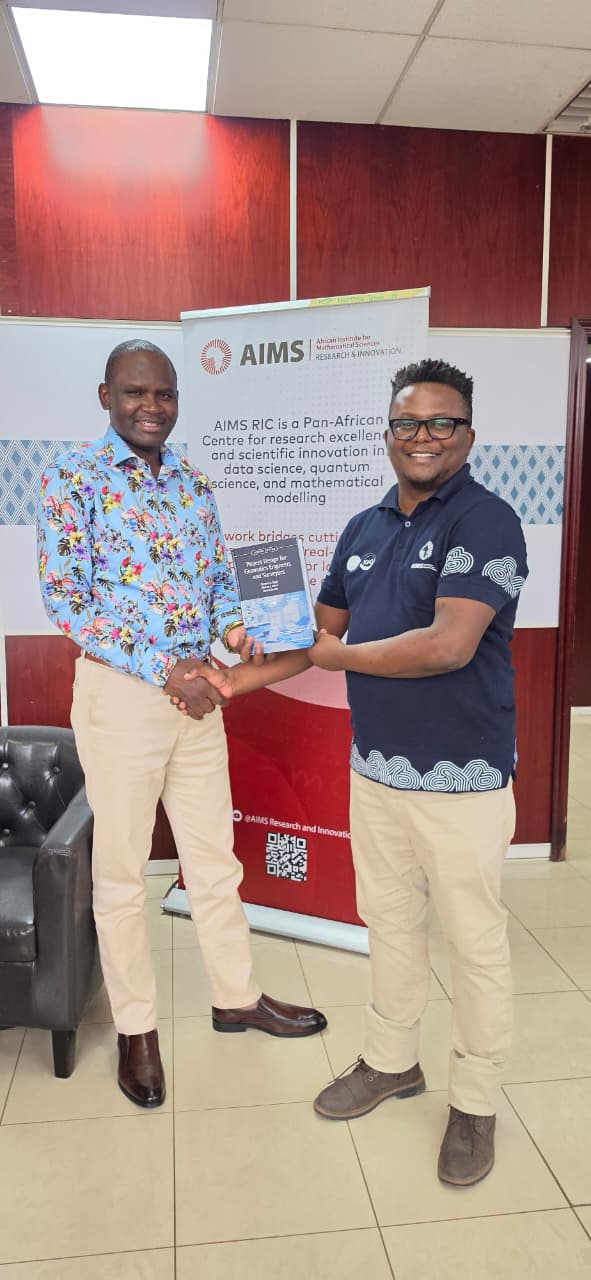
 Handing over an autographed book on geomatics and surveying, fully co-authored by African scholars. AIMS RIC, Kigali, March 27, 2026.
From Voi to Kigali and Back
There are research visits that merely decorate a CV. Then, there are those that stir the mind in fruitful ways. My recent visit to the African Institute for Mathematical Sciences Research and Innovation Centre (AIMS RIC), Kigali, belonged firmly to the latter. From the hilly Voi in Kenya to the hilly Kigali, it was not merely a journey across borders. It was a journey across mindsets, connecting analytical minds.
Why Africa Needs the T-Shaped Neogeneralist Now
On 25th March 2026, I held an interactive session with the doctoral students at AIMS RIC, drawn from all parts of Africa and together weaving a rich tapestry that reflects the continent’s diversity and immense potential. The title of my first talk was The T-Shaped Neogeneralist: A New Skills Revolution for Interdisciplinary Synergies in Research and Development — Examples from Africa’s Mining and Natural Resources Sector
Africa’s future will not be built by narrow specialists alone, but by T-shaped neogeneralists who can mine depth, connect disciplines, and convert knowledge into sustainable transformation.
My first impression, enhanced after conversing with the host, Prof. Cecil N. Ouma, was a wake-up call to African scholars and educators.
I noted that AIMS RIC’s mathematically anchored culture offers a timely lesson for African universities and higher education.
Thus, establishing a niche philosophy that meaningfully cuts across all university programmes is a critical branding strategy. Faculties also need to have Innovation and Technology Transfer Centre Champions.
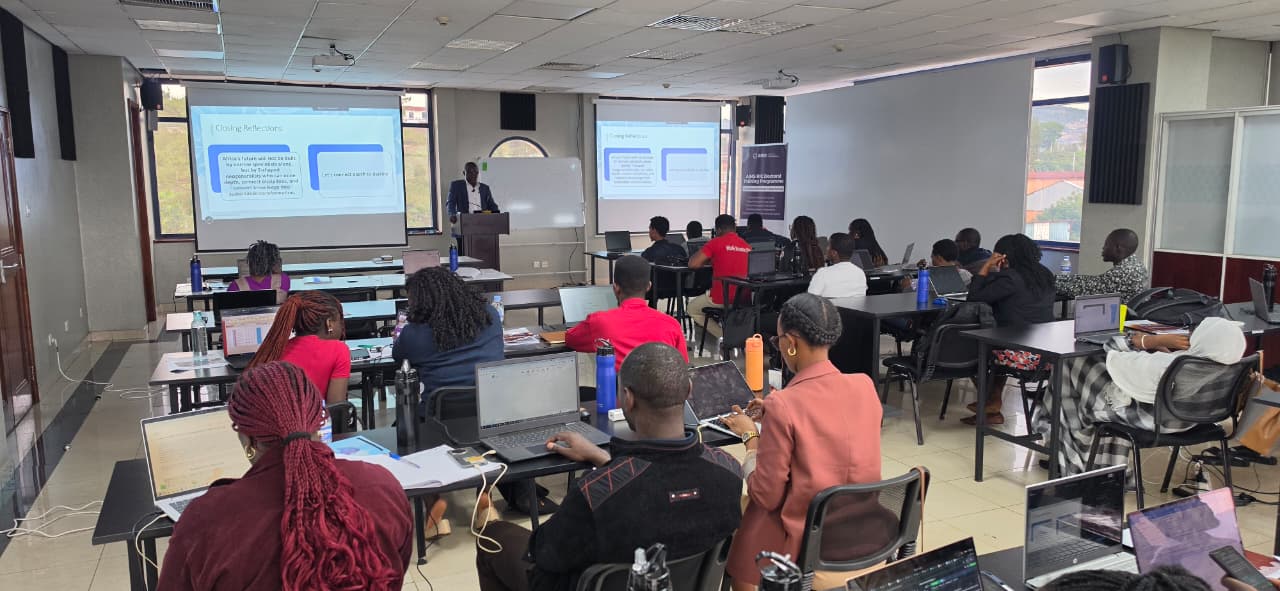 Doctoral students at AIMS RIC, Kigali, during the talk on T-shaped neogeneralists for interdisciplinary synergies in research and development.
For Taita Taveta University (TTU), sustainability in natural resource management, with a laser focus on mining education, offers precisely such a niche. Accordingly, using engineering as an example, every engineering graduate from TTU is prepared to emerge as a distinctly sustainability-oriented professional: a civil engineer with strong grounding in green building technologies; a mechanical engineer well trained in materials engineering cycles for the circular economy; and a mining engineer competently equipped to advance sustainable mining through safety and subsidence engineering, responsible environmental stewardship, traceability and transparency in the mineral value chain, and geodata- and technology-driven rehabilitation of post-mining landscapes. The innovative projects TTU students and alumni have accomplished in similar areas speak for themselves, such as helmets with smart gas sensors for miners in underground environments, AI-enhanced warning systems that predict fires and floods in mining environments, and blockchain technology for end-to-end transparency in tracing mineral origins (including how they are mined and human rights issues) and destinations.
Spotlight on Real-Life Cases of Applied Mathematical Modelling
At AIMS RIC, Kigali, mathematical modelling is treated not as an optional add-on, but as an intellectual anchor for postgraduate training. That orientation strengthens abstraction, policy simulations and scenario testing, optimisation, and feedback-aware reasoning across disciplines.
In my talk, I shared how I have been applying mathematics to develop geodata-driven policy decision-support models in mining and natural resource management and, beyond that perimeter, to socialise mathematics through modelling the winning chances of teams in major football tournaments such as the FIFA World Cup.
To lay an adequate background to the scholarly discussion, I also shared a categorical summary of my work on model taxonomy with the title, “A simplified model taxonomy: A roadmap for informed choice and application”.
Drawing Parallels Between Rwanda and Kenya
Rwanda has, in many ways, become one of Africa’s most visible laboratories of intentional transformation. One sees it not only in public order and institutional ambition, but also in the seriousness with which certain knowledge traditions are being cultivated. At AIMS RIC, mathematical modelling is not treated as an elite side hobby for the mathematically gifted few. It is integral to their way of thinking.
Kenya, on the other hand, has enormous intellectual capital, strategic geography, entrepreneurial dynamism, and university potential. Yet some of our recurring national weaknesses are as follows:
- We often possess islands of excellence without building full archipelagos of coherence – a disheartening seizure of extreme capitalist tendencies and politics of exclusion.
- We have experts, but not always enough integration.
- We have data, but not always decision-ready data.
- We have impressive policy language, but not always feedback-aware policy design.
- We have high ambition and captivating philosophy, but not always sufficient operational mechanisms and modelling culture to convert ambition into robust scenario-tested pathways.
- Ultimately, our endeavours tend to go down the slippery slope that derails our grandiose attempts at translating aspirations into operations.
Translating the Lessons into a Training Philosophy
What I will refer to here as the AIMS RIC Kigali lesson resonates strongly with my track record of research involving applied mathematical modelling to support decisions linked to the mining and natural resources sector in Africa. As the current representative of professionals and academia in the Kenya Chamber of Mines (KCM), I can state that Africa’s mining challenges are no longer merely technical or commercial; they are system-wide, connecting land governance, environment, human rights, communities, productivity, safety, and long-term resilience.
My signature phrase, the “Vicious 10Ds” lens on Africa’s mining sector (i.e., disputes, displacements, dispossession, degradation, discrimination, deprivation, destitution, disease, deformity, and death), reveals how fragmented expertise often reacts to symptoms while missing deeper feedbacks, trade-offs, and delayed consequences.
This is where the Taita-Taveta Integrated Mine Planning Model (TIMPM) becomes instructive. TIMPM demonstrates the move from isolated and linear thinking to integrated and system-wide mine planning by linking mining with water, forest cover, wildlife conservation, agriculture, settlements, infrastructure, ecology, and stakeholder decision support.
Rwanda’s Challenge to Kenya
Rwanda’s example challenges Kenya profoundly. If AIMS RIC primes postgraduate education with modelling, then Taita Taveta University (TTU) can also be vindicated for anchoring all its programmes to mining and natural resource perspectives, with sustainability as the cross-cutting glue. Convincingly, this is how African universities can train scholars and professionals who can connect depth to destiny.
Closing Reflection
This visit was a reminder that Africa’s future will depend less on narrow specialists working in silos and more on T-shaped neogeneralists with both disciplinary depth and interdisciplinary reach.
At AIMS RIC, modelling is used to push scholars from descriptive comfort towards diagnostic, predictive, and design-oriented capability.
I had the following as my parting shot, not only to the AIMS RIC scholars, but to all Africans who appreciate the priceless value of quality education:
Africa’s future will not be built by narrow specialists alone, but by T-shaped neogeneralists who can mine depth, connect disciplines, and convert knowledge into sustainable transformation.
The future-ready African scholar and professional will not be a shallow generalist. Nor will it be the old narrow specialist standing proudly inside a shrinking silo. It will be the mathematically alert, policy-literate, sustainability-conscious specialist with enough horizontal reach to diagnose complexity and design solutions that respect time, space, trade-offs, and human consequence.
Well put Dr. Nashon. Indeed it is the era of T-shaped neogeneralists