
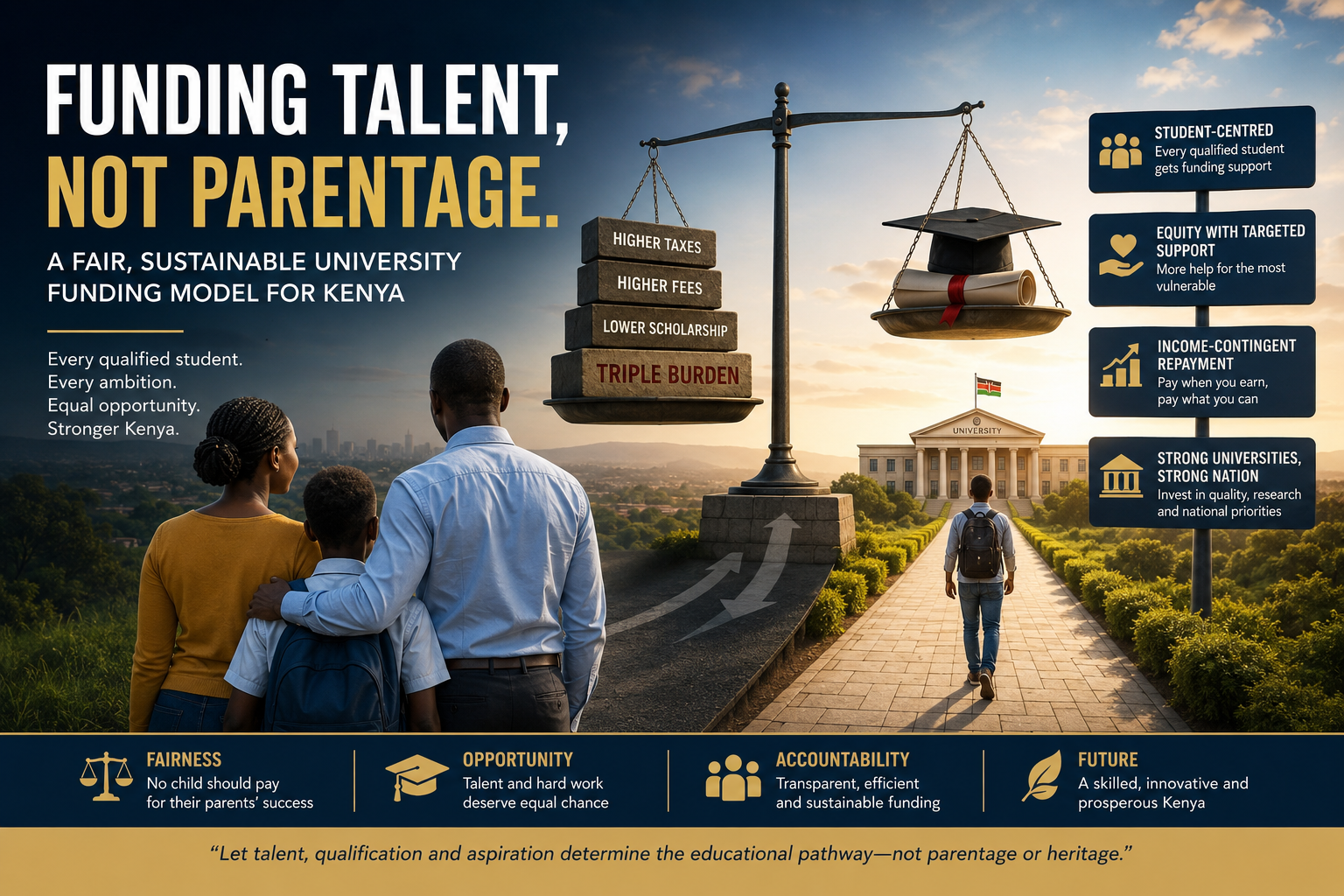
Funding Talent, Not Parentage
An Objective Critique of Kenya’s University Funding Reset
Why universal eligibility, progressive graduate repayment, and transparent programme costing offer a fairer path than fiscalising parental diligence twice
By Nashon J. Adero*, James Indiya, & Peter K. Onsomu | Impact Borderless Digital (IBD) Youth Mentorship Programme | 27 July 2026
*Corresponding author: nashon.adero@gmail.com
The argument at a glance
-
- Every qualified and placed student should have an enforceable public financing guarantee, irrespective of parentage or heritage.
-
- Means testing should target additional support for vulnerability, not determine whether a student may enrol.
-
- Compulsory parental contributions can amount to fiscal triple loading: higher tax, higher education payments, and lower scholarship support.
-
- Any recoverable portion should follow the graduate’s own realised income, not the parent’s previous income.
-
- Universal eligibility is credible only when Parliament defines the grant–loan mix, programme costs, repayment rules, and annual fiscal source.
In this article
| CORE POLICY PROPOSITION Fund every qualified student because qualification matters; support the most vulnerable more because need matters; recover affordable loans from graduates when their own earnings permit; and fund universities adequately because quality costs money. |
|---|
On 21 July 2026, President William Ruto proposed another major reset of Kenya’s higher education financing system (Citizen TV Kenya, 2026a). The announced direction would replace the current five-band, income-based arrangement with a universal student-centred model. As publicly described, every student who qualifies and is placed through Kenya Universities and Colleges Central Placement Service (KUCCPS) in a public university, college, or Technical and Vocational Education and Training (TVET) institution would receive 100 per cent government support; the compulsory household contribution would be removed and any parental top-up would become voluntary; and tertiary financing would be coordinated through a proposed Tertiary Education Funding Authority (TEFA). Because the legislation and implementing regulations are still under parliamentary consideration, these features should be treated as the stated policy design rather than as settled operational law.
The proposal is directionally progressive and deserves serious consideration (Citizen TV Kenya, 2026b). It recognises a principle that should have anchored higher education financing from the beginning:
A qualified Kenyan student should not inherit either educational privilege or educational exclusion from their parents.
However, the phrase “full government funding” must be defined with mathematical, legal, and fiscal precision. Does 100 per cent support mean an entirely non-repayable scholarship, or a government-financed package combining grants, tuition loans, upkeep, accommodation support, and later graduate repayment? Does it cover the full approved programme cost or only a standard reference cost? The distinction determines who ultimately bears the cost and whether the reform is genuinely universal or merely transfers the payment date from enrolment to employment.
A funding model cannot be sustained by the semantic elasticity of political declarations. It must be sustained by legislation, reliable appropriations, transparent formulae, and a social contract that Kenyans can understand.
A Necessary Evolution of the Debate
In a 2023 article, Interrogating Kenya’s New Public University Funding Model: Towards a Needs-Based and Student-Centred Allocation Formula, we acknowledged the rational foundations of student-centred funding and differentiated programme costs. The article nevertheless warned that the model could produce either of two extremes: enhanced quality and equity or wider inequality arising from a poorly managed transition (Adero, 2023).
We further questioned the adequacy of a static Differentiated Unit Cost (DUC) model that did not sufficiently capture changing costs, institutional diversity, the time value of money, or optimisation under resource constraints. We also called for a Means Testing Instrument (MTI) whose integrity, transparency, and responsiveness could be trusted by students and parents.
Three years later, the arithmetic has become even more demanding. Kenya recorded 993,226 graded KCSE candidates in 2025, with 27.18 per cent attaining C+ and above. The higher education system has consequently entered an era of mass demand in which, as we observed earlier, a policy designed for an elite university system will “fail by arithmetic alone” (Adero, 2026).
The question is therefore no longer whether Kenya should reform university funding. Reform is unavoidable. The real question is whether the country can design a model that simultaneously achieves access, equity, quality, legal certainty, institutional sustainability, and intergenerational fiscal responsibility.
From Five Bands to Universal Eligibility: What Is Actually Changing
The proposed reform is not simply a change in scholarship percentages. It shifts the organising principle of the system from parental means to student qualification and placement. The table below consolidates the publicly described differences and separates the genuine gains from the questions that remain unresolved.
Table 1. Current five-band model and proposed universal funding model
| Policy dimension | Five-band model (current) | Universal model (proposed) | Key advantage, gain, or unresolved issue |
|---|---|---|---|
| Organising principle | Parent-centred and income-based. | Student-centred and qualification-based. | Moves the primary entitlement from the parents’ measured income to the student’s academic qualification and placement. |
| Eligibility and classification | Students are sorted into five financial bands through a digital Means Testing Instrument (MTI). | Every qualifying KUCCPS-placed student in a public university, college, or TVET institution is promised 100 per cent state support. | Removes band-placement risk, including the danger of inaccurate classification where informal-economy income and household obligations are difficult to verify. |
| Household contribution | A mandatory out-of-pocket family contribution forms part of the approved funding package. | Any household top-up becomes voluntary rather than an enforced condition for admission or continuation. | Reduces deferment and dropout risk caused by upfront fee demands, while allowing families that wish to do so to reduce a student’s future loan exposure. |
| Funding of the programme | Universities Fund scholarship + HELB student loan + compulsory family contribution. | Direct state-supported financing per student, with the final scholarship-loan composition to be specified in law and regulations. | Simplifies the access guarantee, but ‘100 per cent funding’ must disclose what is grant, what is loan, what covers upkeep, and what the graduate must later repay. |
| Administrative architecture | Funding functions are divided among the Universities Fund, HELB, the TVET funding structure, and related placement processes. |
A proposed Tertiary Education Funding Authority (TEFA) would centralise tertiary financing; the broader reform direction also seeks closer integration of placement and funding, following earlier Cabinet-level approval of the enabling framework (Executive Office of the President, 2026). |
A single window can reduce duplication, but merging institutions is not a substitute for adequate appropriations, audited disbursement, independent appeals, and clear service standards. |
| Role of needs assessment | The MTI determines the core scholarship, loan, and household contribution package. | Needs assessment should no longer determine whether the student can enrol; it may still target extra grants, upkeep, accommodation, disability support, or emergency assistance. | Preserves progressive support for vulnerability without allowing parentage or a disputed income score to become an access barrier. |
| Transition risk | Known band rules, but recurring disputes over classification, affordability, disbursement, and appeals. | Legislation, regulations, fiscal source, transition of legacy loans, and precise benefit coverage remain to be finalised. | Parliament must resolve these matters before implementation so that universal funding is an enforceable compact rather than a politically attractive but underfunded promise. |
The proposal’s strongest gain is the removal of the compulsory household contribution and five-band MTI classification as gates to access. Its greatest unresolved weakness is the ambiguity of the phrase “100 per cent state funding”: Parliament must state, in advance, the grant-loan mix, the costs covered, the repayment rules, and the annual fiscal source.
What the Student-Centred Model Got Right
An objective critique must acknowledge the strengths of the model introduced in 2023.
First, it recognised that university programmes do not cost the same. Medicine, engineering, architecture, mining, and other laboratory-, clinical-, field-, or equipment-intensive programmes cannot be funded at the same rate as programmes requiring fewer specialised facilities and fewer supervised contact hours.
Second, it made the cost of university education more visible. The older system concealed much of the actual programme cost behind apparently uniform fees and irregular government capitation.
Third, it attempted to direct larger scholarships to the most vulnerable students. Under the five-band Student-Centred Funding Model, each student’s package was assembled from a direct Universities Fund scholarship, a HELB loan, and a mandatory household contribution, with the proportions determined through a digital Means Testing Instrument (MTI). The model’s equity intention was defensible, but its dependence on household-income classification exposed students to disputed band placement, uncertain data, and appeals that could outlast the period in which fees were due.
Fourth, it adopted the defensible principle that public funding should follow the student, creating incentives for institutions to attract and retain learners through quality, relevance, and reputation.
These are not trivial achievements. Any replacement model should retain programme-cost differentiation, student-centred allocation, institutional accountability, and additional protection for genuinely vulnerable students.
Where the Model Became Fundamentally Unfair
The central flaw was not the pursuit of equity. It was the decision to make parental circumstances, interpreted through five income-based bands and a digital Means Testing Instrument, a major gateway through which an adult or nearly adult citizen’s educational opportunity had to pass.
A student who has attained the prescribed university entry requirements is a rights-bearing citizen with an individual talent profile, an individual career aspiration, and an individual future income trajectory. The student is not merely an appendage of a parental payslip.
The funding system effectively asked, ‘How much do your parents earn?’ before fully answering, ‘What have you qualified to study?’
This produced an ethically and economically questionable transfer of responsibility. A parent who had studied diligently, passed examinations, built a career, entered the formal tax system, and consistently paid higher taxes could be required to contribute more directly towards a child’s education while simultaneously receiving a smaller public scholarship.
Meanwhile, another parent with a lower measured income could pay less tax, make little or no household contribution, and receive greater public funding for a child pursuing the same programme.
Redistribution towards vulnerable households is legitimate and necessary. But the cumulative burden imposed on formally employed and professionally successful parents can become excessive when progressivity is applied repeatedly through taxation, reduced scholarships, and increased household contributions.
The Triple Loading of Parental Income
Let:
-
- Yₚ = a parent’s measured income;
-
- T(Yₚ) = taxes and statutory charges paid by that parent;
-
- H(Yₚ) = compulsory household contribution towards university education; and
-
- S(Yₚ) = the public scholarship allocated to the child.
The equations below use browser-native mathematical markup. They remain selectable and accessible rather than being embedded as images.
The parent’s net fiscal burden associated with the funding arrangement may be represented as:
𝐵𝑝 = 𝑇(𝑌𝑝) + 𝐻(𝑌𝑝) − 𝑆(𝑌𝑝) (1)
Under a strongly means-tested model:
𝑑𝑇/𝑑𝑌𝑝>0, 𝑑𝐻/𝑑𝑌𝑝>0, 𝑑𝑆/𝑑𝑌𝑝<0 (2)
Therefore:
𝑑𝐵𝑝/𝑑𝑌𝑝 = 𝑑𝑇/𝑑𝑌𝑝 + 𝑑𝐻/𝑑𝑌𝑝 − 𝑑𝑆/𝑑𝑌𝑝 (3)
All three components increase the net burden as parental income rises. The higher-income parent pays more tax, is assigned a higher direct education contribution, and loses part of the public scholarship otherwise available to the child.
This is more than ordinary progressive taxation. It is fiscal triple loading.
The argument is not that high earners should cease supporting redistribution. A progressive tax system is an essential feature of an equitable society. The concern is that progressivity should principally be administered through a coherent national taxation system, not repeatedly imposed through every public service used by a taxpayer’s family.
Otherwise, formal employment, professional advancement, declared income, and diligence begin to resemble fiscal liabilities.
The Band-Cliff Problem
The use of income bands creates a further distortion. Suppose a household’s annual income rises by ΔY, causing it to cross a funding-band threshold. Its tax liability increases by ΔT, its required university contribution increases by ΔH, and its scholarship falls by ΔS.
The effective marginal burden becomes:
𝐸𝑀𝐵 = (𝛥𝑇+𝛥𝐻−𝛥𝑆)/𝛥𝑌 (4)
Consider a purely illustrative case in which a household’s annual income rises by KES 120,000. After crossing a funding threshold, annual tax and statutory deductions rise by KES 24,000; the university household contribution rises by KES 30,000; and the child’s scholarship falls by KES 60,000.
24,000+30,000+60,000 = KES 114,000 (5)
𝐸𝑀𝐵 = 114,000/120,000 = 95% (6)
The household retains only KES 6,000 of the KES 120,000 income improvement. This is a classic benefit cliff. It can discourage formalisation, income disclosure, promotion, additional work, and professional advancement. It also creates arbitrary differences between households situated immediately below and immediately above a threshold.
A continuous funding function is more defensible than rigid bands.
Parenthood Is Not a Reliable Student-Financing Institution
The five-band model also appeared to assume that parents would willingly and continuously finance their adult children whenever a Means Testing Instrument classified them as capable. The proposed universal model directly challenges that assumption by making household contributions voluntary rather than an enforced prerequisite for admission or continued study.
That assumption is unsafe. Households may have mortgages, medical expenses, ageing dependants, several children in education, unstable employment, family separations, disability-related costs, or unrecorded obligations. Gross income is not the same as disposable capacity.
Moreover, the historic expectation that an educated child will later support ageing parents is no longer an enforceable or predictable economic contract. Some children support their parents generously; others are unable or unwilling to do so. Migration, unemployment, high living costs, changing family structures, and individual autonomy have weakened the certainty of intergenerational repayment.
Public policy should not compel parents to make a large investment based on an assumed future return that is neither legally guaranteed nor actuarially measurable.
The person who receives the primary lifetime earnings benefit from university education is the graduate. Where cost recovery is necessary, repayment should therefore follow the graduate’s realised income, rather than the parent’s past income.
The Legal Warning Should Not Be Ignored
In December 2024, the High Court criticised significant aspects of the Variable Scholarship and Loan Funding Model, including its statutory foundation, public participation, household-income classifications, predictability, and potential discrimination. The judgment also questioned the realism of some household classifications and the ambiguity surrounding household income and the appeals mechanism (Kenya Law, 2024).
The Court of Appeal subsequently stayed the prohibitory orders, permitting the model to continue pending determination of the appeal. The legal dispute nevertheless provides important policy lessons: a university funding model must be established transparently through legislation, parliamentary scrutiny, meaningful public participation, and clear administrative-review procedures (Universities Fund, 2026b).
The current proposal should not repeat the history of launching first and legislating later.
Universal Funding Must Not Be Confused with an Identical Free Grant
President Ruto’s universal-funding proposal corrects the parentage problem by promising 100 per cent state support to every qualifying KUCCPS-placed student in public universities, colleges, and TVET institutions, while making any family top-up voluntary. It nevertheless introduces another question: should a student from a wealthy household and a student without food, accommodation, or family support receive identical non-repayable grants?
Not necessarily.
Universal eligibility is different from uniform subsidy. Under the proposed approach, the State can guarantee the full financing package for every qualified student without necessarily converting the entire package into an identical grant. Giving every student the same non-recoverable scholarship could itself become regressive, particularly where government revenue includes consumption taxes paid by poor households. The policy challenge is therefore to abolish means testing as an access gate while retaining carefully designed additional support for vulnerability.
The solution is not to abandon need-based support. It is to reposition it. Means testing should determine additional scholarships, upkeep grants, accommodation support, assistive services, emergency assistance, and the grant-loan composition of the funding package. It should not determine whether a qualified student can enrol or whether the student’s parents must finance the programme.
A Fairer Universal Qualified-Student Funding Model
Kenya should establish a Universal Qualified-Student Funding Guarantee, founded on six components.
1. A Transparent Programme Reference Cost
For programme j in year t, let the reference cost be:
𝐶𝑗𝑡 = 𝑘𝑗𝑡/𝑟𝑗𝑡[𝐹𝑗𝑡(1 + 𝐼𝑗𝑡/𝑆𝑗𝑡)] + 𝐿𝑗𝑡 + 𝑃𝑗𝑡 (7)
Where:
-
- kⱼₜ = workload and training intensity factor (1.0 for a standard classroom-based learning). The training intensity factor measures how much extra teaching effort, practical exposure, equipment, supervision, and institutional resources a programme requires. It should not be chosen arbitrarily; it should be calculated from evidence such as contact hours, laboratory time, fieldwork requirements, staff ratios, equipment use, and accreditation standards;
-
- rⱼₜ = appropriate student-to-staff ratio;
-
- Fⱼₜ = weighted academic and technical staff cost;
-
- Iⱼₜ/Sⱼₜ = infrastructure-to-staff-cost ratio;
-
- Lⱼₜ = laboratory, clinical, fieldwork, workshop, and industrial-placement cost; and
-
- Pⱼₜ = quality assurance, digital learning, and professional-accreditation cost.
The value should be indexed annually for inflation, technology costs, professional standards, and justified changes in delivery requirements. This extends the programme-cost logic discussed in my 2023 article while making explicit the costs that determine quality.
2. A Universal Foundational Grant
Every qualified and placed student should receive a foundational public scholarship:
𝐺ij0 = 𝛼𝐶𝑗𝑡 (8)
Here, α is a nationally determined universal grant proportion. This grant belongs to the student by virtue of qualification and placement, not parental income.
3. A Continuous Needs-Based Supplement
Let the student’s need score be:
𝑁𝑖 = 𝑤1(1−𝑌∼𝑖) + 𝑤2𝐷𝑖 + 𝑤3𝑉𝑖 + 𝑤4𝑅𝑖 + 𝑤5𝐸𝑖 (9)
Subject to:
0≤𝑁𝑖≤1, ∑𝑤𝑘 = 1 (10)
Where the variables represent normalised disposable household resources per dependant, dependency burden, vulnerability or disability, regional and cost-of-living disadvantage, and exceptional circumstances such as orphanhood, displacement, or sudden income loss.
The additional grant becomes:
𝐺ij𝑁 = 𝛽𝑁𝑖𝐶𝑗𝑡 (11)
Unlike rigid bands, this function changes gradually. A small income increase therefore produces a small funding adjustment rather than a punitive scholarship cliff.
4. A Student Loan for the Remaining Tuition Cost
The tuition loan would be:
𝐿𝑖𝑗 = 𝐶𝑗𝑡 − 𝐺ij0 − 𝐺ij𝑁 (12)
The compulsory parental contribution should be:
𝐻𝑖 = 0 (13)
Parents who wish to reduce their child’s future loan may make a voluntary contribution:
𝑃𝑖𝑣≥0 (14)
Accordingly:
𝐿ij* = 𝐿𝑖𝑗 − 𝑃𝑖𝑣 (15)
Parental support becomes voluntary, not a condition for accessing the course for which the student has qualified.
5. Income-Contingent Graduate Repayment
Repayment should commence only when the graduate’s personal income exceeds a protected threshold Y∗:
𝑅𝑖(𝑡) = 𝜌max[0, 𝑌𝑖(𝑡) − 𝑌*] (16)
Where Yᵢ(t) is the graduate’s own income at time t, Y∗ is the protected minimum income, and ρ is an affordable repayment rate.
A graduate who earns below the threshold pays nothing during that period. A successful high-earning graduate repays more rapidly. The debt may be subject to a maximum repayment period, protection during unemployment, and transparent rules on interest and inflation adjustment.
This relocates responsibility from parental history to graduate outcome. It also aligns with the general principle used in income-contingent student-loan systems in countries such as Australia and the United Kingdom, where repayment obligations activate above defined income thresholds (Australian Department of Education, 2026; UK Government, 2026).
6. A Unified but Accountable Funding Authority
The proposed Tertiary Education Funding Authority (TEFA) can reduce fragmentation by providing one application, assessment, disbursement, records, recovery, and appeals platform for tertiary students. A unified authority could also improve data consistency and make it easier to track the complete public investment attached to each student.
Institutional consolidation, however, is not itself a funding model. TEFA should be established with a statutory funding formula, a protected and independently reviewable appeals process, published semester-level disbursement calendars, audited programme-cost data, service standards, and explicit transition rules for existing HELB loans and obligations inherited from the Universities Fund and TVET financing bodies.
Funding Must Also Protect Universities
Student financing alone cannot sustain a university system.
Universities produce research, maintain laboratories and libraries, preserve specialised disciplines, support postgraduate training, and carry national capabilities that cannot always be financed through student fees. Strategic programmes with low enrolment may nevertheless be indispensable to national development.
Government should therefore maintain separate institutional funding for research and innovation, capital infrastructure, postgraduate supervision, expensive national-priority programmes, disability inclusion, quality improvement, staff development, and regional or strategically located institutions.
The funding model must not reduce universities to vendors waiting for tuition payments attached to individual students.
The Fiscal Adequacy Test
The National Assembly reported an allocation of KES 56.7 billion to the Higher Education Loans Board in the 2026/27 budget (National Assembly of Kenya, 2026). Public reporting also placed the allocation for university scholarships below the amount institutions and students were projected to require (The Star, 2026a). The adequacy question becomes more urgent under a universal model because the State would guarantee support to the entire qualifying and placed cohort, while public explanations of the proposal have referred not only to tuition but also to accommodation and living expenses.
A universal model must therefore pass a funding-adequacy test:
𝐹𝐴𝑅𝑡 = Actual annual appropriation/Assessed annual funding requirement (17)
For credible implementation:
𝐹𝐴𝑅𝑡≥1 (18)
A model whose funding-adequacy ratio is below one is not fully funded, irrespective of its official name, a standard also implicit in cross-country comparisons of tertiary student support (OECD, 2022).
The law should require the Government and the proposed TEFA to publish the ratio annually, together with student numbers, programme costs, scholarship obligations, loan disbursements, upkeep and accommodation support, recoveries, arrears, institutional shortfalls, appeal turnaround times, and the proportion of approved funding actually released before each semester begins.
The Policy Tests Parliament Must Apply
Before approving the proposal, Parliament should establish whether:
- ‘Full funding’ means a grant, a loan, or a transparent combination of both.
- Every qualified and placed student has an enforceable funding entitlement.
- Means testing affects supplementary support rather than access.
- Parental contribution is optional rather than compulsory.
- Programme costs are independently verified and periodically reviewed.
- The need-assessment algorithm, variables, weights, and appeal procedures are publicly available.
- Funding is protected through multi-year appropriations rather than annual promises.
- Public and private accredited institutions can receive student-linked support up to an approved reference cost where this expands access or offers better value.
- Universities receive separate institutional grants for research, infrastructure, and national strategic functions.
- Graduate loan repayment is linked to the graduate’s actual income and protected against unemployment, disability, and economic shocks.
- The proposed TEFA has a legally clear mandate, transparent governance, independent appeals, audited service standards, and a funded transition plan for legacy institutions and loans.
- The implementation regulations define whether 100 per cent support covers tuition, upkeep, accommodation, equipment, fieldwork, and other compulsory programme costs, and distinguish the non-repayable grant from the recoverable student loan.
Conclusion: Fund the Citizen Who Qualified
President Ruto’s proposal creates an opportunity to correct an underlying injustice in the previous model: a qualified student’s access would no longer depend on surviving a five-band household classification, an uncertain digital MTI assessment, or a compulsory family payment made before study could continue.
Working parents should contribute to national development through a fair and progressive tax system. They should not then face an additional compulsory education surcharge merely because discipline, examinations, sacrifice, and professional diligence placed them in a higher income category.
Children should not be penalised for their parents’ diligence. They did not inherit their parents’ examination results, and they should not inherit a reduced claim on public investment because their parents succeeded.
At the same time, universality must not erase vulnerability. Students without food, housing, devices, transport, or family support require more assistance than those from secure households. Equity demands differentiated additional support, but equality demands a common entrance guarantee.
Fund every qualified student because qualification matters. Support the most vulnerable more because need matters. Recover affordable loans from graduates when their own success permits because outcomes matter. Fund universities adequately because quality costs money.
The answer is neither an opaque means-tested parental burden nor an unaffordable promise of identical free education for everyone.
It is a legally grounded, fiscally funded, student-centred, and mathematically transparent model that separates a child’s educational future from the parent’s payslip.
Kenya’s policymakers must now rise to the occasion. The country does not need a fourth experiment built around a new slogan. It needs a durable higher education financing compact founded on fairness, predictability, quality, and national talent development. The move from five bands to universal eligibility is a major conceptual gain; the decisive test is whether Parliament converts that gain into enforceable entitlements, credible appropriations, transparent graduate repayment rules, and an accountable funding authority.
Let talent, qualification, and aspiration determine the educational pathway—not parentage, heritage, or the fiscal punishment of parental diligence.
References
Source note. The reference list follows APA 7 conventions: entries arranged alphabetically by author or organisation, presented in sentence case. Policy descriptions are current as at 27 July 2026; the final legal design remains subject to Parliament and implementing regulations. Numerical examples are illustrative unless a source is expressly identified.
Adero, N. J. (2023, May 31). Interrogating Kenya’s new public university funding model: Towards a needs-based and student-centred allocation formula. Impact Borderless Digital. https://impactborderlesdigital.com/2023/05/31/interrogating-kenyas-new-public-university-funding-model-towards-a-needs-based-and-student-centred-allocation-formula/
Adero, N. J. (2026, January 11). KCSE 2025: Consolidation year in gender shift, enrolment expansion, and a persistent performance tail. Impact Borderless Digital. https://impactborderlesdigital.com/2026/01/11/kcse-2025-consolidation-year-in-gender-shift-enrolment-expansion-and-a-persistent-performance-tail/
Australian Government Department of Education. (2026, June 16). HELP indexation and debt reduction. https://www.education.gov.au/higher-education-loan-program/help-students/help-indexation-and-debt-reduction
Citizen TV Kenya. (2026a, July 21). Government proposes fully funded tertiary education for all students [Video]. YouTube. https://www.youtube.com/watch?v=ElbzNb1HjEs
Citizen TV Kenya. (2026b, July 22). Ruto’s university funding reforms draw mixed reactions [Video]. YouTube. https://www.youtube.com/watch?v=DZAd4_F6NzQ
Executive Office of the President. (2026, February 10). Cabinet news: February 10, 2026 [Press release]. https://www.president.go.ke/wp-content/uploads/CABINET-NEWS-FEBRUARY-10-2026.pdf
GOV.UK. (n.d.). Repaying your student loan: How much you repay. Retrieved July 27, 2026, from https://www.gov.uk/repaying-your-student-loan/what-you-pay
Kenya Human Rights Commission & 4 Others v Cabinet Secretary, Ministry of Education & 4 Others; Universities Fund & 3 Others (Interested Parties), [2024] KEHC 16369 (KLR) (High Court of Kenya, December 20, 2024). https://new.kenyalaw.org/akn/ke/judgment/kehc/2024/16369/eng@2024-12-20
National Assembly of Kenya. (2026, June 5). National Assembly approves 2026/27 budget, prioritising health and education sectors. https://www.parliament.go.ke/node/25878
OECD. (2022). How much do tertiary students pay and what public support do they receive? In Education at a glance 2022: OECD indicators. OECD Publishing. https://www.oecd.org/en/publications/education-at-a-glance-2022_3197152b-en/full-report/component-27.html
The Star. (2026a, June 11). Education allocation rises by Sh81.8bn to hit Sh784.5bn in 2026–27 budget. https://www.the-star.co.ke/news/2026-06-11-education-allocation-up-by-sh818bn-to-hit-sh7845bn
The Star. (2026b, July 21). Ruto announces full state funding for university and college students. https://www.the-star.co.ke/news/2026-07-21-ruto-announces-full-funding-for-varsity-students
Universities Fund. (2025, April 9). Court of Appeal reinstates higher education funding model. https://www.universitiesfund.go.ke/court-of-appeal-reinstates-higher-education-funding-model/
Universities Fund. (n.d.). New higher education funding model. Retrieved July 27, 2026, from https://www.universitiesfund.go.ke/new-higher-education-funding-model/
Suggested citation: Adero, N. J., Indiya, J., & Onsomu, P. K. (2026). Funding talent, not parentage: An objective critique of Kenya’s university funding reset. Impact Borderless Digital (IBD).
When you say “a qualified Kenyan student should not inherit either educational privilege or educational exclusion from their parents,” doesn’t that overlook the fact that educational privilege starts much earlier? Kids from well-off families usually have access to better schools, tutoring, and learning resources, which increases their chances of becoming “qualified” in the first place
In fact, people succeed due to those privileges, but even more people so succeed despite those privileges. So, they eventually cancel out and every child deserves that funding in the long run.
Great article!
Great article! When you say “a qualified Kenyan student should not inherit either educational privilege or educational exclusion from their parents,” doesn’t that overlook the fact that educational privilege starts much earlier? Kids from well-off families usually have access to better schools, tutoring, and learning resources, which increases their chances of becoming “qualified” in the first place